



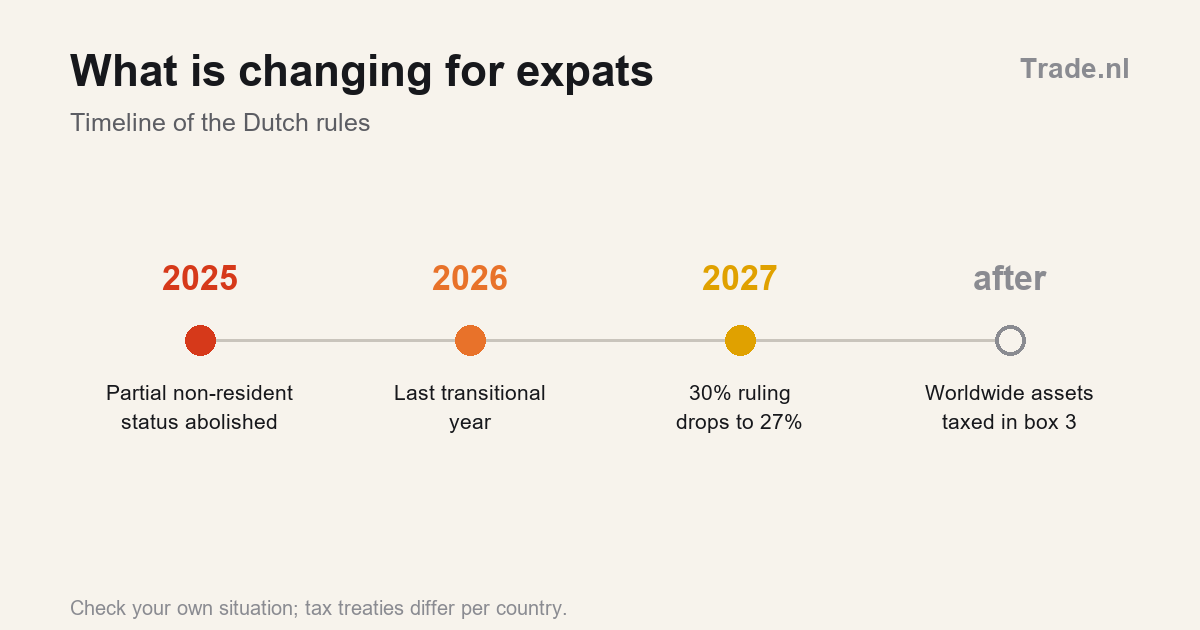
If you are a tax resident of the Netherlands, your worldwide assets are taxed in box 3, the Dutch wealth tax. The partial non-resident status, which used to exempt foreign assets for holders of the 30% ruling, was abolished as of 2025, with a transitional arrangement running to 2026 for people who already held the ruling in 2023. The 30% ruling itself stays at 30% in 2026 and drops to 27% from 2027. To open an account with a Dutch broker you generally need a BSN, a Dutch address and a bank account in your own name.
Plenty of guidance exists for Dutch investors, and almost none for the roughly one million internationals living here. Yet the questions are different: which broker will even accept you, how your assets abroad are treated, and what happens to your tax position when the 30% ruling ends. This guide covers the Dutch specifics. It is factual information, not tax advice.
The Dutch system taxes wealth, not gains
The biggest surprise for most newcomers is that the Netherlands does not levy capital gains tax on ordinary private investments. Instead, box 3 taxes your assets, based on their value on 1 January.
The practical consequences are unusual. Selling at a profit does not trigger a tax bill, so rebalancing or switching brokers is fiscally harmless. But a year with poor returns can still produce a tax bill, because the levy follows your wealth rather than your profit. Box 3 is being reformed towards taxing actual return, so check the rules for the year you are filing.
Partial non-resident status is gone
This is the change that matters most and that many expats have missed.
Holders of the 30% ruling used to be able to opt for partial non-resident taxpayer status. In practice that kept assets in boxes 2 and 3, including foreign bank accounts and investment portfolios, outside Dutch taxation. That option was abolished as of 2025. There is a transitional arrangement: people who were already applying the 30% ruling in 2023 can use the status for the last time in 2026.
If you are a Dutch tax resident and the transitional rule does not apply to you, your worldwide assets fall under box 3. That includes a brokerage account in your home country, a foreign savings account and, in most cases, property abroad, although a tax treaty may prevent double taxation on real estate.
What happens to the 30% ruling
The ruling lets an employer pay part of your salary as a tax free allowance for the extra costs of living abroad. For 2026 the rate remains 30%. From 1 January 2027 the maximum drops to 27%.
Worth planning for: the ruling affects your net salary, not your investments. Since the partial non-resident status disappeared, having the ruling no longer shelters your portfolio from box 3.
Opening an account with a Dutch broker
Dutch brokers must identify you under anti money laundering rules. In practice you will need:
- A BSN, your Dutch citizen service number, issued when you register with your municipality.
- A Dutch residential address.
- A bank account in your own name, usually Dutch or at least within SEPA, used to verify your identity and to pay out.
- Valid identification, normally a passport or EU identity card.
US citizens are a special case. Because of FATCA reporting obligations, several European brokers decline American clients or restrict which products they may buy. Check this before you start an application.
What to look for as an international
- English support and documentation. Some brokers run their platform in English but send statements and tax overviews in Dutch only.
- An annual tax statement. A clear overview of your position on 1 January makes your box 3 declaration far easier.
- Currency conversion costs. If you keep investing in dollars or in your home currency, conversion fees can quietly cost more than the trading commission.
- Fund domicile. Irish domiciled UCITS funds usually lose less dividend to withholding tax for European investors than alternatives.
- Portability. If you may leave the Netherlands again, ask what happens to your account and whether positions can be transferred abroad.
Wat kost beleggen je per jaar?


If you leave the Netherlands
When you stop being a Dutch tax resident, your box 3 obligation ends for the years after departure, but the year of your move is usually split. Some brokers will keep your account when you move within the EU and close it when you move outside it.
Tax treaties determine which country may tax what, and they differ per country. For anything beyond the basics, and certainly if you hold assets in several countries, it pays to consult a Dutch tax adviser. The cost is usually small compared with the risk of getting it wrong.
Veelgestelde vragen
If you are a Dutch tax resident, yes. Worldwide assets fall under box 3. The partial non-resident status that used to exempt them was abolished as of 2025, with a transitional arrangement to 2026 for those who held the 30% ruling in 2023.
Not for ordinary private investments. Box 3 taxes the value of your assets rather than the profit you make, so selling at a gain does not by itself create a tax bill.
For a Dutch broker, in practice yes, together with a Dutch address, identification and a bank account in your own name.
The rate stays at 30% for 2026 and falls to 27% from 1 January 2027. The ruling affects your salary, not the taxation of your investments.